A vegan friend shared this story with me recently, and I haven’t been able to stop thinking about it.
She had posted an image on instagram of a cow being led to slaughter whilst another in the line, looked away. Any vegan knows that the suffering of those animals is undeniable.
A non-vegan woman responded to the post saying, “Thank you for posting this”.
The vegan, excited by the response, replied: “Oh, are you vegan too?”
The non vegan replied, “Oh no, I’m not.”
And here’s where it gets interesting.
My vegan’s next response was something like, “You should consider how healthful and tasty vegan food is.”
Here’s what I told her: You had her. And then you lost her.
The 5-Second Window
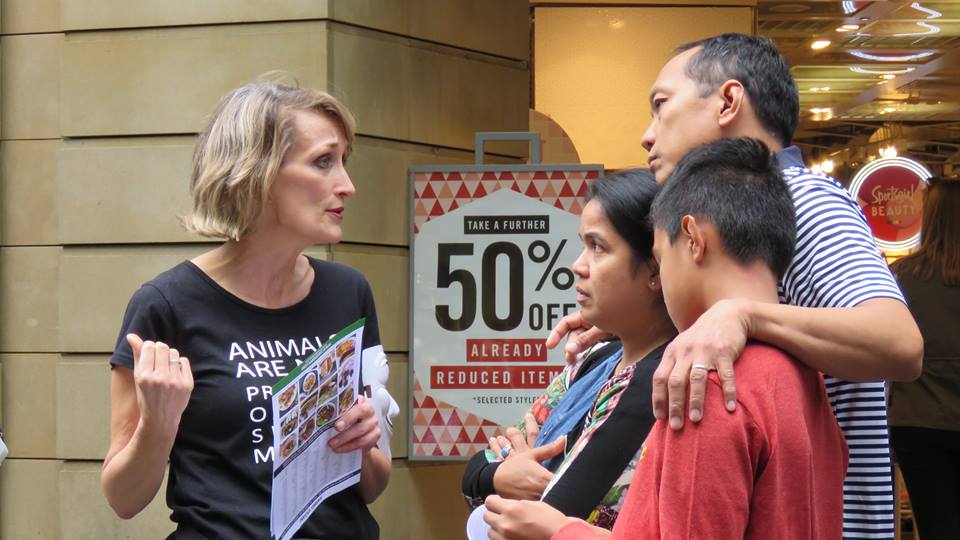 When someone expresses an emotional connection to animal suffering—even briefly, even tentatively—there’s a window that opens.
It’s maybe five seconds. Maybe ten.
In that moment, they’re actually FEELING the disconnect between their values and their actions.
They’re standing in the doorway of empathy, looking at something they usually keep carefully out of view.
This is the most potent moment for influence that exists.
And most of us—with the best intentions—immediately redirect them away from it.
We pivot to health. To the environment. To how delicious vegan food is.
We do everything except help them stay with what they’re actually feeling.
What Really Happened in That Exchange
Let’s look at what was actually happening:
She saw the image of the cow. She presumably felt something powerful enough that she thanked someone for posting it. She was affected.
Now let’s look beyond this exchange to what I often see happen in these situations.
Let’s imagine we have a woman reacting to some story, image or video about animal suffering. She responds in some way that indicates she is affected.
She is standing in the doorway.
And instead of inviting her to stay there—to feel more, to explore what was stirring in her—we change the subject to recipes and nutrition.
We let her off the hook.
Why?
- Because we’re uncomfortable with other people’s discomfort.
- Because we’ve been told not to be “too emotional” about veganism.
- Because we think facts and logic are safer than feelings.
- Because we don’t actually know what to say when someone is feeling it.
The Response That Changes Everything
Here’s what we might be tempted to say: “You should consider how healthful and tasty vegan food is.”
Here’s what we could have: “What was it about that image that affected you?”
Do you see the difference?
- One response gives her an escape route back to logic and justification.
- The other invites her to go deeper into the feeling.
- One lets her put the barrier back up.
- The other asks her to stay in the doorway a little longer.
The Question: “What was it about that image that affected you?”
This question does something powerful:
- It asks her to articulate the empathy she’s already feeling.
- It invites her to connect more deeply with what she saw.
- It creates space for her to feel the full weight of the disconnect within herself.
You’re not lecturing her. You’re not positioning yourself above her. You’re simply asking her to stay with what’s already there.
Why We Avoid the Emotional Path
I hear vegans say all the time: “I became vegan for the environment” or “for health.”
And I understand why.
It’s a safe place to land. A place where the person does’t have to feel the full agony of what animals endure or, if they do, it’s deemed to be a better way to reduce resistance from in someone who has asked you why thet’re vegan. A place where they can make it about data and logic rather than grief and moral reckoning.
But here’s what I’ve learned:
The people who transform most deeply are the ones who let themselves feel it.
Not the ones who found the right argument.
The ones who allowed themselves to sit with the discomfort of knowing.
And when someone shows you they’re feeling it—even for five seconds—your job isn’t to rescue them from that feeling.
Your job is to help them stay there long enough for it to matter.
The Skill We’re Not Teaching
Many vegan advocacy training focuses on:
- The best documentaries to recommend
- How to respond to “protein though” arguments
- Recipes to share
- Environmental statistics
- Being kind to animals
All of these useful and important.
But we’re not teaching the most critical skill: How to recognize when someone is emotionally connected, and how to deepen that connection rather than redirect it.
- We’re not teaching vegans to be comfortable with other people’s discomfort.
- We’re not teaching them to ask the question that invites someone to feel more, not less.
- We’re not teaching them that fanning empathy is more powerful than listing facts.
She Was Already on the Path
Here’s the good news about my friend’s exchange on instagram.
That woman felt something when she saw that image. She connected, even briefly, with the reality of what happens to animals.
She’s already on the path.
She may not go vegan tomorrow. She may not even think about it again for months.
But something shifted. A door opened, even if just a crack. A seed has been planted and we don’t know when it be watered or harvested.
The question for you is:
Next time someone shows you that door is open, will you help them walk through it?
Or will you redirect them to a conversation about quinoa?
What to Say When They Feel It
The next time someone expresses emotional connection to animal suffering, try this:
Instead of: “You should try vegan food—it’s so healthy!”
Try: “What was it that affected you about that?”
Instead of: “Have you seen Cowspiracy? The environmental impact is huge.”
Try: “It sounds like that really landed for you. What are you feeling?”
Instead of: “I have great recipes I can share with you.”
Try: “A lot of people feel that disconnect. What makes it hard for you to act on what you’re feeling?”
These questions don’t let them escape.
They invite them to go deeper.
They ask them to feel the full weight of the gap between what they know and what they do.
And that gap—that discomfort—is where transformation happens.
Nudging People Along the Continuum of Awareness
I’m not suggesting you trap people in emotional manipulation.
I’m suggesting you recognise that when someone is already feeling something, your role is to help them explore that feeling, not distract them from it.
You’re not creating the empathy. It’s already there.
You’re just asking them to stay with it long enough to let it inform their choices.
That’s the nudge.
Not a lecture. Not a guilt trip. Not a list of reasons.
Just an invitation to feel what they’re already feeling—and to sit with it a little longer.
The Path Forward
The woman who thanked the vegan for posting that image is on a journey now, whether she knows it or not.
She saw something. She felt something.
Next time she sees an image like that, she’ll feel it again. And maybe a little more deeply.
Next time someone asks her what affected her, maybe she’ll have an answer.
Next time the disconnect surfaces, maybe she’ll be ready to do something about it.
Your job isn’t to convert her in one conversation.
Your job is to help her stay connected to what she’s already feeling—and to trust that empathy, once awakened, doesn’t go back to sleep easily.
If you want to become the kind of communicator who knows what to say in these moments—who can recognise the 5-second window and use it skillfully, let’s talk.
I work with vegans who are ready to move beyond scripts and statistics and learn how to meet people where they actually are.
Book a free conversation and get clarity on your next step: https://veganpsychologist.com/conversation